

In the world of corporate L&D, “soft skills training” has long been the industry’s most persistent challenge. While we can easily teach a technician how to repair a circuit board through a 2D branching scenario, teaching a manager how to navigate a high-tension termination or help a team through a period of psychological instability is notoriously difficult.
The reason? Emotional stakes.
Traditional eLearning often feels like an “observer” experience. You watch a video, you read a script, and you choose the “best” response. But there is a profound disconnect between knowing the right answer and feeling the pressure to deliver it.
As we move into 2026, the toolset for bridging this gap has evolved. We are no longer limited to the “talking head” video. By leveraging Unreal Engine, we are moving into the era of Environmental Storytelling—a technique borrowed from AAA game design that uses visual fidelity and spatial context to drive the emotional engagement necessary for true behavioral change.
What is Environmental Storytelling?
At its core, environmental storytelling is the art of “showing, not telling.” It is the practice of embedding narrative clues within a 3D space so that the learner discovers the story through observation rather than exposition.
In a traditional course, a narrator might say: “The office is tense because of recent layoffs.” In an Unreal Engine sandbox, you don’t need the narrator. The learner walks into a virtual office and sees:
- A half-packed cardboard box on an empty desk.
- A flickering fluorescent light that adds a rhythmic, unsettling pulse to the room.
- A “Team Photo” on a cubicle wall where one face has been scratched out or removed.
- The sound of a distant, muffled argument coming from behind a closed boardroom door.
This is Narrative Stratigraphy—layering the environment with “artifacts” of human emotion. When a learner discovers these details, their brain moves from passive acquisition to active interpretation. They aren’t just taking a course; they are stepping into a situation that feels lived-in, urgent, and real.
1. The Psychology of Visual Fidelity
Many skeptics argue that “photorealism” in training is an expensive luxury. However, in soft-skills training, visual fidelity serves a specific neurological purpose: The Suspension of Disbelief.
When we use Unreal Engine’s Lumen (real-time global illumination) and Nanite (virtualized geometry), we aren’t just making things look “pretty.” We are creating a sense of Presence.
The “Anxiety of the Space”
Soft skills are often tested in uncomfortable environments. Using Unreal Engine, we can manipulate the lighting and atmosphere to mirror the internal state of the characters.
- High-Stakes Negotiation: Use harsh, high-contrast lighting and cold blue tones to create a sense of clinical isolation.
- Conflict Resolution: Use a cluttered, cramped office space to simulate the “trapped” feeling participants often report during difficult conversations.
When the environment matches the emotional weight of the dialogue, the learner’s sympathetic nervous system engages. Their heart rate increases slightly; their focus sharpens. They are no longer “playing a game”—they are practicing in a state of physiological arousal that mirrors the real world.
2. Narrative Props: The “Silent SMEs”
In a 3D soft-skills simulation, every object in the room is a “Silent Subject Matter Expert.” These objects provide context that informs how the learner should approach a conversation.
Imagine a leadership simulation where you must coach an underperforming employee. Before the conversation begins, the learner is encouraged to “walk the floor.”
- Observation A: You see a “Star Performer” award from two years ago, now covered in dust.
- Observation B: You see a calendar on the desk with several missed personal appointments circled in red.
- Observation C: You notice the employee’s workstation is positioned with its back to the rest of the team.
By the time the learner initiates the dialogue (perhaps with an AI-driven MetaHuman), they aren’t just “managing an underperformer.” They are helping a person whose story they have already begun to piece together. The empathy is “earned” through discovery, making the subsequent soft-skills practice significantly more impactful.
3. From “The Click” to “The Interaction”
The shift from 2D storyboards to Unreal sandboxes changes our instructional verbs. We move from Click/Next to Observe/Interpret/Act.
Building the “Golden Path” vs. the “Edge Cases”
Using Unreal’s Blueprint Visual Scripting, we can create environments that react to the learner’s emotional choices. If a learner chooses an aggressive tone in a soft-skills simulation:
- The lighting might subtly shift to a warmer, more aggressive red hue.
- The ambient audio might cut out, leaving an uncomfortable, ringing silence.
- The MetaHuman character might break eye contact and start fidgeting with a specific prop you noticed earlier.
This immediate, environmental feedback loop is far more powerful than a “Incorrect. Please try again” text box. It shows the learner the consequences of their social behavior in real-time.
4. Measuring What Matters: Spatial Data Analytics
Perhaps the most professional advantage of using Unreal Engine for soft skills is the data. In 2026, we are no longer satisfied with “completion data.” We want Behavioral Telemetry.
Through xAPI integration within Unreal, we can track:
- Gaze Path: Did the learner notice the “narrative props” that explained the employee’s stress?
- Proximity: Did the learner stand too close to the NPC during a conflict, potentially escalating the situation?
- Decision Latency: How long did the learner hesitate when presented with an ethical dilemma?
This data allows us to provide a level of feedback that was previously impossible. We can tell a learner: “You passed the conversation, but you missed 60% of the environmental cues that would have told you the employee was experiencing burnout, not laziness.”
The Path Forward for Instructional Designers
For those of us with years of experience in traditional ID, the leap to Unreal Engine can feel daunting. But remember: The engine is just the stage. You are still the playwright.
The technical skills—learning Blueprints, understanding lighting, or importing assets—can be learned. But the ability to craft a narrative that drives a specific learning outcome? That is the core expertise of an Instructional Designer.
As we look toward the future of L&D, the most successful designers will be those who stop thinking in “slides” and start thinking in “spaces.” By using environmental storytelling, we aren’t just teaching people what to say; we are giving them a world where they can learn how to be.
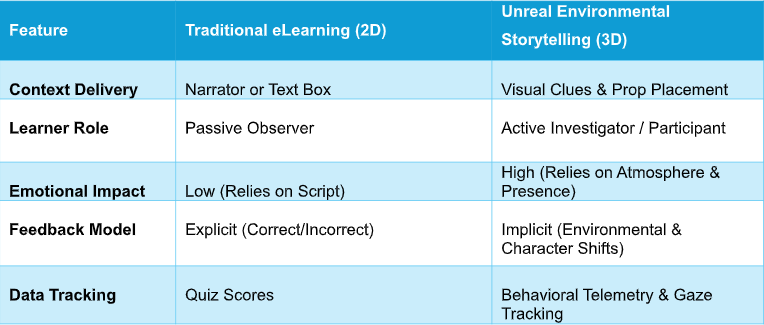
Comparison: Traditional vs. Environmental Storytelling
Final Thought
If you are building your portfolio today, don’t just show that you can build a course. Show that you can
build a world. Show that you understand how a flickering light or a discarded coffee cup can be just as
instructional as a bulleted list.
In the sandbox of 2026, the environment is the teacher.

April 1, 2026